

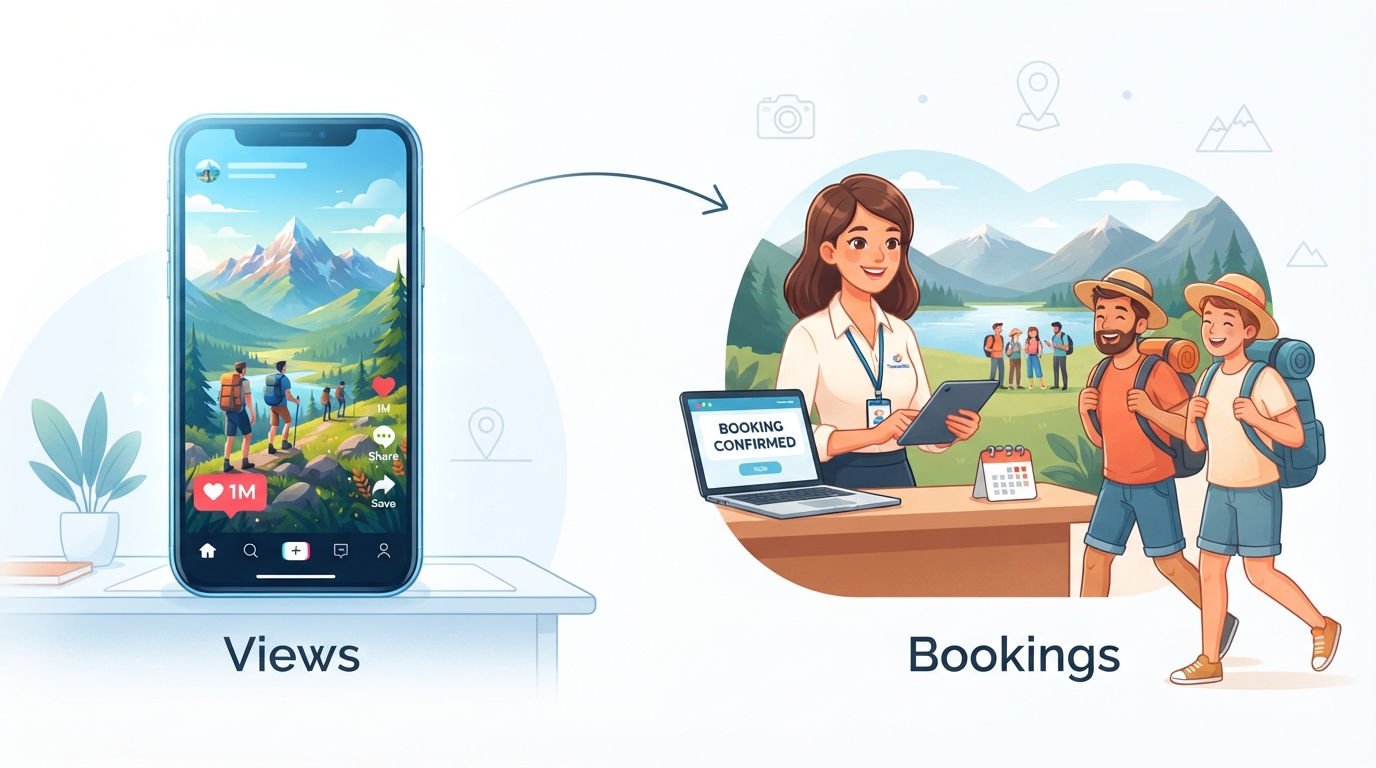
Short-Form Video for Tour Operators: What Converts, What Just Collects Views
An operator we know spent most of a winter learning to make Reels. He studied the trends, bought a gimbal, and by spring he had a video with over a million views: a beautifully edited sequence of his coastline at golden hour, set to whatever audio was inescapable that month. He was, briefly, famous.
We asked him at the end of the season how many bookings the million views produced. He had checked, because he is honest with his numbers. The answer was somewhere between four and none; attribution was fuzzy, but the booking spike he expected never came. Meanwhile another operator in the same region posted rougher, phone-shot clips of her actual guests laughing through her actual tour, rarely broke ten thousand views, and could trace bookings to specific videos because guests kept saying "we saw the video of the lady with the oysters."
Both operators made video. Only one made marketing. The difference between them is the entire subject of this post.
The trap: optimizing for the platform instead of the booking
Short-form platforms reward watch time and shares. Booking decisions run on something else entirely: a viewer concluding "that could be me, there, having that." These two goals overlap less than the marketing advice industry suggests.
The million-view video failed as marketing for reasons that were visible in advance. It was placeless in practice; a viewer in another country enjoying a pretty coastline has no reason to note which coastline. It was person-less; no guests, no guide, nothing to imagine yourself into. And it competed in the most saturated category on every platform: generic beautiful travel footage, where you are up against every drone owner on earth.
Views are the platform paying you in its own currency. That currency converts to bookings at a terrible exchange rate unless the video was built for conversion from the start.
What actually converts: the three videos worth making
Watch which videos operators can trace bookings to, and the same three shapes keep appearing.
The guest-experience clip. Real guests, visibly enjoying the specific thing you do: the gasp at the viewpoint, the toast at the last stop, the kid steering the boat. This is the workhorse. It sells because prospective guests are not buying scenery, they are buying themselves having a good time, and footage of people like them having that time is the most literal possible proof. It also needs no production values; authenticity outperforms polish in this category so consistently that over-editing is a downgrade.
One practical note: get consent. A brief line in your booking terms plus a verbal heads-up at the start of the tour ("we film short clips for social media, wave us off if you'd rather not appear") covers most situations, keeps you on the right side of guests, and, in much of the world, the law. Be extra careful with children; when in doubt, film them from behind or not at all.
The guide-personality clip. Your guide, to camera, telling one story from the tour: the shortest version of the legend, the one fact that makes everyone say "no way," the answer to the question every guest asks. This works because people book people. A guide with visible charisma is your most defensible differentiator, impossible for a competitor to copy, and these clips let prospects meet them before booking. It is also the format that builds a following rather than just impressions.
The insider-knowledge clip. Useful, specific local knowledge generously given: where to actually eat near the landmark, what time the crowds arrive, what to skip. This earns saves and shares from people planning trips to your destination, which is precisely the audience you want. The video does not sell the tour; it establishes you as the person who knows, and the profile does the selling.
Notice what is absent: trend-chasing, dances, generic drone montages. Those can earn reach, and reach has some brand value. But a small account converting steadily beats a big account converting never.
The system that survives your busy season
The reason most operators' video efforts die is not ability; it is that video gets treated as a separate creative project, and separate creative projects lose to the two o'clock departure every single time. The fix is making capture part of operations rather than an extra job.
Capture on every tour, in seconds. Ten to twenty seconds of phone footage per departure, shot by the guide at natural moments, is enough raw material for everything. Make it a lightweight habit with two or three standing shots (the reaction moment, the group at the finish, one product beauty shot) so nobody has to be creative at nine in the morning.
Batch the making. One hour a week, turn the week's clips into two or three posts. That cadence, sustained, beats a burst of daily posting that dies in July. Consistency at a modest pace compounds; heroics do not.
Reuse ruthlessly. The same clip works across every short-form platform, in your email newsletter, on your booking pages, and in your review-request messages. A video on the product page, showing real guests on that product, is quiet conversion work long after the platforms have forgotten it.
Point every video somewhere. Profile link current, destination named in the caption, and where the platform allows it, a plain next step. Viewers do not hunt for your booking page; the path has to be lying at their feet.
Paid amplification: pouring fuel only on fires that already started
Once organic posting has run for a season, a disciplined next step exists: putting small paid budgets behind clips, and only behind the right ones. This is where most operator ad money gets wasted, so the rules deserve stating plainly.
Never boost to fix a weak video. The near-universal mistake is paying to promote the polished brand video that organically flopped, on the theory that it just needed reach. It did not; the audience already voted. Paid distribution multiplies whatever a video does organically, including nothing. The only clips worth money are the ones that already over-performed with your organic audience: unusual watch-through, saves, shares, comments from strangers. Let the free audience run the audition; pay only the winners.
Aim the money at people who can actually book. Reach means nothing from viewers who will never visit your destination. The targeting that works for operators is narrow and boring: people currently in or recently arrived at your destination for a last-minute push, people in your key source markets who have shown travel intent toward your region for the planning window, and warm audiences built from your own guest list and engaged viewers for cheap, high-converting retargeting. A locals-focused product flips this and targets residents within an hour's drive, which is some of the cheapest inventory available because no tourist business bids on it.
Spend like a scientist, not a sponsor. Modest daily amounts across two or three proven clips, run for a couple of weeks, judged against one question: did attributed bookings, link taps, and "found you on" mentions move, and at what cost per booking versus your other channels? Platform dashboards will drown you in engagement metrics; ignore everything that is not a step toward a checkout. If the numbers work, scale the budget gradually on the same winning clips until they fatigue. If they do not work after a fair test, stop without sentiment; organic short-form can be a perfectly good channel for an operator whose paid math never closes.
The sequencing is the whole doctrine: organic finds what resonates, paid multiplies it, and never the reverse. Operators who follow that order spend embarrassingly little to real effect. Operators who start with the ad budget fund the platform's shareholders and learn nothing.
Judge it like a channel, not a hobby
Set expectations honestly: short-form video is a slow-compounding channel, hard to attribute cleanly, and the guests it influences often arrive by another door, searching your name a week after seeing a clip. The clean-looking metrics (views, likes) are the least meaningful ones; the meaningful signals are profile visits, link taps, "saw you on Instagram" mentions at check-in, and direct traffic drifting upward over a season.
Do what our oyster-lady friend does: ask at booking or check-in how guests found you, and log it. She tracks that channel answer against bookings in Dazhboards the same way she tracks everything else in her marketing, which is how she knows her rough guest clips outsell polished footage, and it is the only reason her winter is spent filming guests instead of coastlines. The platforms will always tell you the pretty video won. Your booking data is the only witness that never flatters.