

The Last-Minute Booking Window: How It Shifted Post-2023 and What to Do About It
If you've been running tours for more than five years, you've probably noticed something has changed about when customers book. The patterns that held in 2019 don't hold now. The customers who used to book two months ahead are booking ten days ahead. The customers who used to book ten days ahead are booking on the morning of. The forward-booking curve has compressed in ways that are visible if you look at your own data and easy to miss if you don't.
This isn't a small operational footnote. It changes how you staff, how you price, how you market, and how you manage inventory. The operators who have adapted are running their businesses differently than they did in 2019. The ones who haven't are using a playbook designed for a world that doesn't quite exist anymore.
Here's what the shift actually looks like and what it means for the work.
The Pre-2020 Pattern
For most of the 2010s, the booking window pattern in our industry was relatively stable. Customers planning a trip to your destination typically booked tours and activities two to six weeks ahead. The exact timing varied by product type (high-end private experiences booked further out, casual walking tours booked closer in), but the curve was predictable.
The implications for operators were also predictable. Inventory could be released methodically. Marketing campaigns could be timed weeks ahead of seasonal peaks. Pricing could be set conservatively, with the assumption that most departures would fill steadily over a multi-week window. Staff schedules could be set with confidence based on forward bookings two to three weeks out.
This whole system depended on customers behaving in a stable, planning-ahead way. They mostly did, and operators built their businesses around that assumption.
What Changed
The shock of 2020 to 2022 broke the pattern, and the patterns that emerged in 2023 and consolidated in 2024 and 2025 have stayed in place. The honest summary: customers book later, decide faster, and tolerate less commitment than they used to.
Several specific shifts are worth understanding individually.
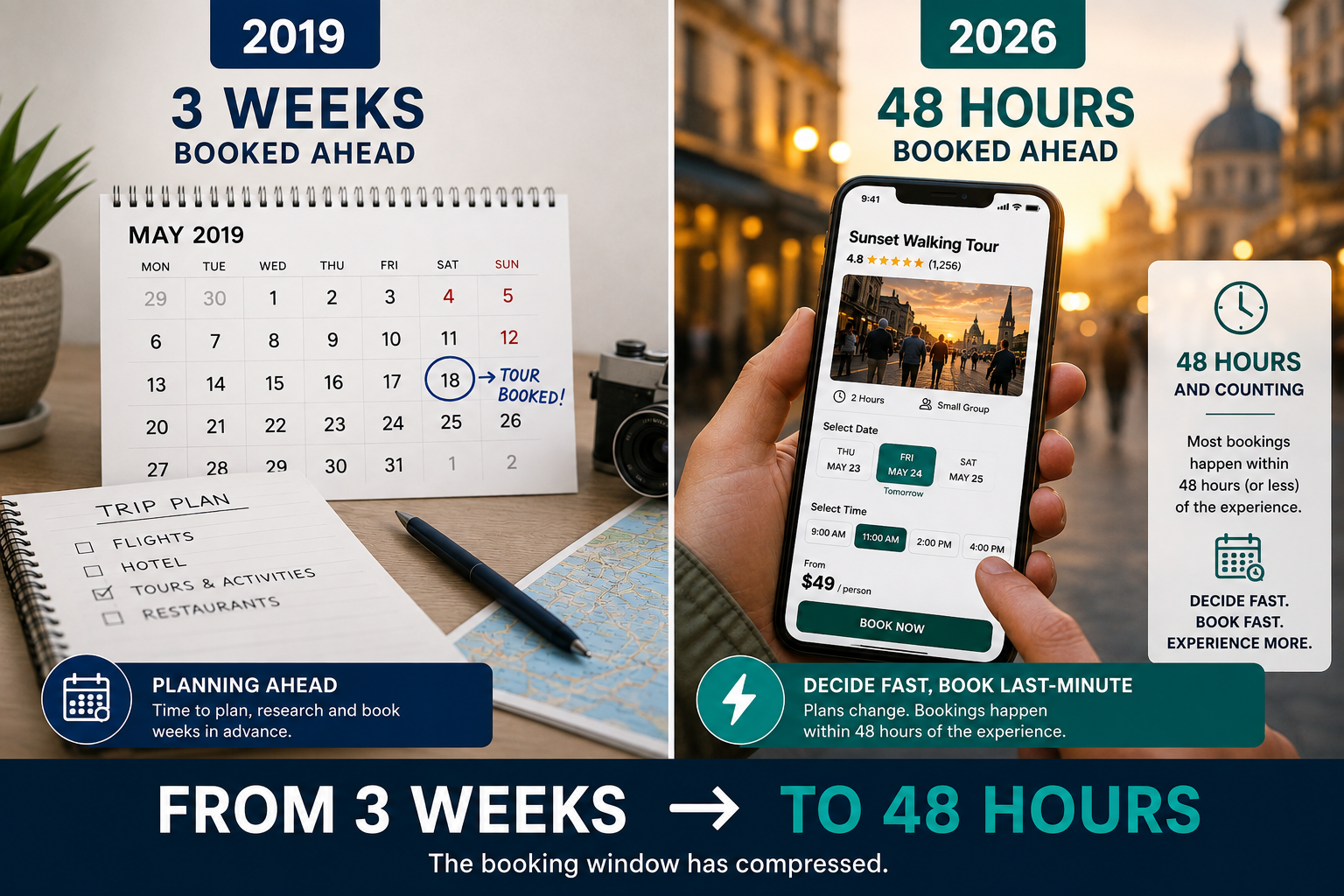
The booking window has compressed. Industry observers have tracked this consistently across destinations and product categories. Where the median booking arrived three to four weeks before the experience in 2019, the equivalent median in 2026 sits closer to one to two weeks. The shift varies by product, by market, and by season, but it's directionally consistent.
Last-minute bookings have grown disproportionately. The share of bookings arriving within 48 hours of the experience has grown substantially in many destinations. For some product categories (urban walking tours, casual short experiences), same-day bookings have become a meaningful share of total volume.
Forward-booking depth has shrunk. The number of bookings on the books two months out, as a percentage of eventual season totals, has declined across most operator categories. The implication: operators have less forward visibility into how their season is shaping up than they used to.
Customers expect flexibility. Booking later correlates with expecting easier cancellation, more flexible terms, and faster operator response when plans change. The customer who booked twenty hours ago expects the operator to be reachable in real time, not on next business day terms.
The reasons for these shifts are probably multiple and interlocking: changed traveller psychology after the pandemic, improvements in mobile booking technology, OTA app behaviours that trained customers to book casually, generally increased comfort with last-minute decision-making in many parts of life. The causes matter less than the effects.
What This Means Operationally
The compression of the booking window has practical implications across the business that most operators have absorbed incompletely.
Staffing certainty is lower. Two weeks out, you have less confidence about Saturday's load than you used to. The pre-season practice of locking staff schedules months ahead is harder to defend, because the bookings those schedules were predicated on aren't there yet. Operators are increasingly building schedule flexibility into their staffing models, with confirmed shifts plus on-call capacity.
Capacity planning is more reactive. The departure that would have been confirmed two weeks out at six bookings is now confirmed two days out at twelve bookings. The decision points have moved closer to the actual departure. Operators who set firm thresholds for cancelling under-booked departures need to push those decision points later, because the bookings that fill the departure often arrive in the last 72 hours.
Marketing spend timing has shifted. Campaigns that were timed to drive forward bookings four weeks out now produce better return when timed closer to the departure window. The customer who's going to book Saturday's tour isn't usually thinking about it three weeks ago; they're thinking about it Wednesday or Thursday.
Inventory management is more important. When most of your bookings arrive in the final week, the choices you make about which departures to release, which to hold, and which to cancel become more consequential. The operators with disciplined inventory systems handle the late-arriving demand better than those running their schedule on a spreadsheet.
What This Means Commercially
Beyond operations, the shift creates commercial implications worth thinking about.
Pricing has more leverage at the close. With more demand arriving in the final week, the prices set for that final week matter more than they used to. Operators who hold a single rack rate from confirmation to departure may be leaving money on the table on departures that are tight on capacity, or selling out at prices below what the late-arriving demand would have paid.
This is the operational case for some form of dynamic pricing, even modest. Holding firm at the rack price on the Wednesday before a sold-out Saturday departure is leaving demand-revenue on the table.
Last-minute distribution channels matter more. Customers booking in the final 48 hours are often using different channels than customers booking three weeks out. Mobile-first booking, OTA mobile apps, and Google Things to Do all skew toward last-minute. Operators whose distribution mix is optimised for the older two-week booking window may be missing the channels where the newly-shifted demand actually lives.
Cancellation policy interacts with this. Customers booking later are more sensitive to flexibility than customers booking earlier. The cancellation terms that felt reasonable in a two-week-out booking world feel restrictive in a one-week-out world. Operators whose cancellation policies haven't been revisited since pre-2020 are likely losing conversion to OTAs whose policies are calibrated to current customer expectations.
What To Actually Do About It
A few moves consistently help operators adapt to the new pattern.
Look at your own data. The first move is understanding your own booking window curve, not the industry average. Pull twelve months of bookings, plot when they arrived versus when the experience happened, and look at how that curve has shifted from prior years. Most operators are surprised by what they see. The shift in your business may be larger or smaller than the industry pattern.
Adjust your forward-visibility expectations. If your business now books mostly in the final two weeks, planning your operation as if you had four weeks of visibility creates anxiety and bad decisions. Build your weekly cadence around the actual booking pattern, not the one you wish you had.
Move your marketing closer to the booking window. Whatever spend you have on demand generation should be calibrated to when customers actually convert. If the conversion happens in the final week, the awareness and consideration activity needs to ramp meaningfully in the weeks before, not months before.
Make sure your booking flow handles last-minute well. A booking system that requires manual confirmation, or that doesn't allow booking within a few hours of departure, is losing the entire growing segment of last-minute demand. The system needs to support real-time availability, real-time confirmation, and mobile-first checkout for the late-arriving customer to convert.
Build the late-departure pricing tier. Even a simple two-tier model (booked more than 72 hours out at one price, booked within 72 hours at a different price) captures more of the demand curve than a flat rack rate. The direction of the differential is yours to set; for many operators the late price is higher (reflecting the demand pressure on the final spots), while for others a late discount is used to fill the genuinely under-booked departures. Either way, having the tooling to differentiate is worth more than it was five years ago.
What Hasn't Changed
Worth a brief note on what's stayed stable, because not everything is different.
The total demand for tour and activity experiences in most destinations has continued to grow over the post-2020 period. The shift is in when customers book, not whether they book. Operators who interpret the booking window compression as evidence of weak demand are misreading the data.
High-end private and premium experiences still book on longer windows than commodity shared experiences. The compression is real across the board but more pronounced for casual products. A private fishing charter valued at $1,500 still books three to six weeks ahead in most cases.
Local repeat customers behave differently from tourist customers. The shift is more pronounced in destination tourist markets than in markets serving local repeat business. Operators with strong local customer bases have seen less compression than operators serving primarily out-of-state or international tourists.
A Closing Thought
The booking window shift is one of those changes that's easy to dismiss as a footnote and hard to fully internalise. The full operational and commercial implications take time to work through, and the operators who adapt earliest tend to be the ones who eventually outperform.
The work isn't dramatic. It's recalibrating staffing models, rebuilding marketing calendars, adjusting pricing tiers, modernising the booking flow. Each piece individually is incremental. The cumulative effect, over a couple of seasons, can be substantial.
Dazhboards' sales tracking and operations modules surface the booking window data alongside the operational tooling to act on it, so the lateness of the curve becomes a manageable feature of the business rather than an anxiety-producing surprise each week. The shift is what it is; how operators set themselves up around it is still substantially their choice.