

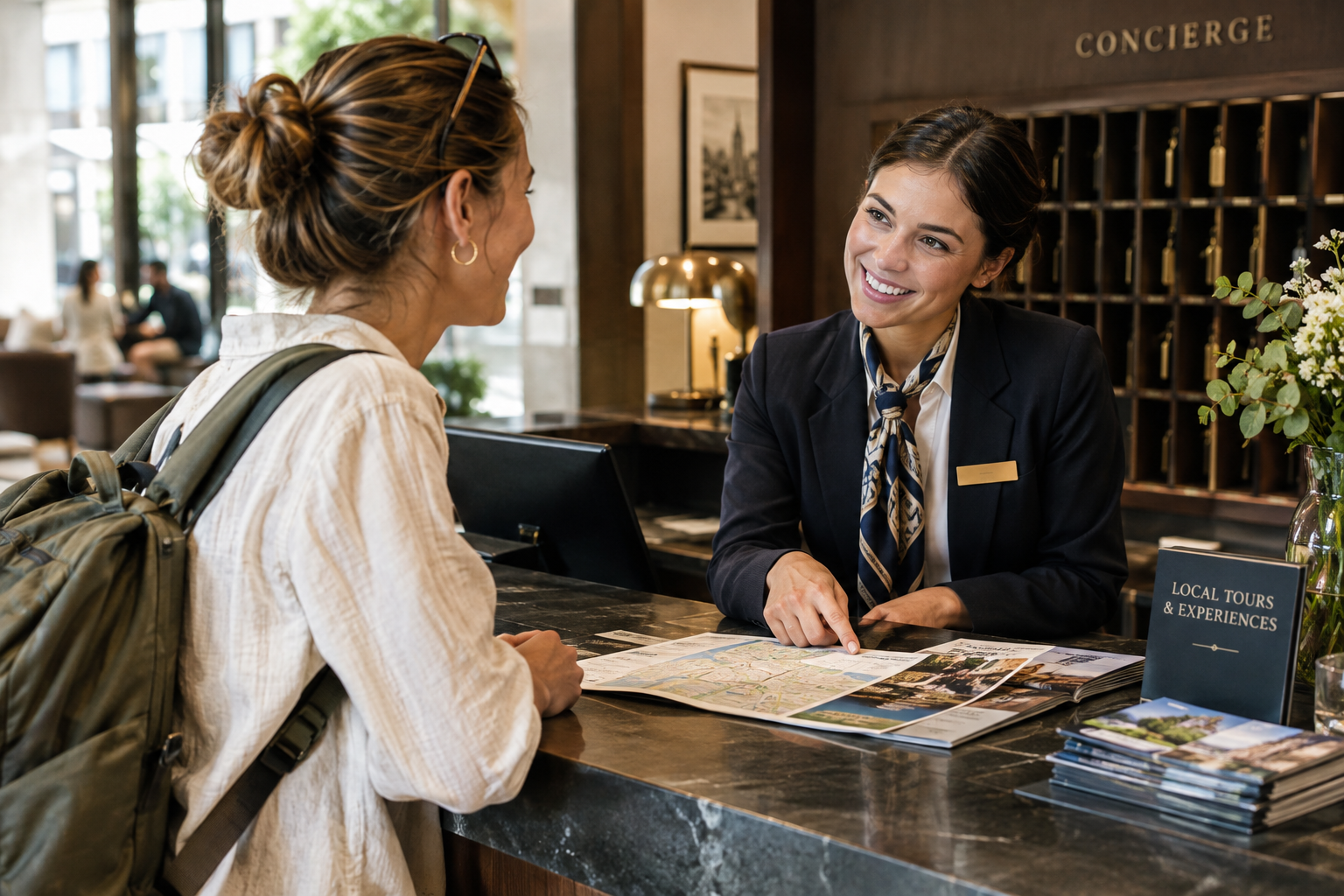
The Distribution Channel Sitting Ten Minutes From Your Office: Hotels, Concierges, and Local Partners
Years ago we watched a small food tour operator in Lisbon do something that changed how we think about distribution. She spent one morning a week, every week, visiting hotels. Not the big chains with formal concierge programs; the twenty-room boutiques and guesthouses within walking distance of her meeting point. She brought pastries, left cards, learned the front desk staff by name, and offered every property's team a free spot on the tour
Within two seasons, roughly a third of her bookings came through those relationships. No commission negotiations with platforms, no bidding on keywords, no algorithm changes to fear. Just front desk staff answering the question every city guest asks, "what should we do tomorrow?", with her name.
Most of us obsess over online channels, direct versus OTA, and treat local partnerships as an afterthought or a relic. That is a mistake. The guest standing in a hotel lobby asking for a recommendation is the highest-intent lead in your city, and reaching them costs shoe leather instead of ad spend.
Why local referral converts like nothing else
Think about what a hotel recommendation carries that no online listing can. The guest asked for it, so intent is proven. It comes from a person they have already decided to trust with their stay. It arrives at the exact moment of decision, usually for the next day or two, so there is no consideration window in which to forget or comparison-shop. And it lands with no competing options beside it, unlike a search results page with forty rivals.
That combination is why partner referrals convert at rates that make your website funnel look broken, and why the guests who arrive this way tend to show up, tip well, and review generously. They were pre-sold by someone they trust before you ever met them.
Mapping your partner landscape
Local B2B is broader than hotels. Sketch the map for your own city and it usually includes:
Accommodation, tiered. Boutique hotels and guesthouses where the owner or a small team makes recommendations personally; larger hotels with formal concierge desks; and hosts of short-term rentals, who increasingly send guests a digital guidebook and are often glad to include a trusted operator in it.
Adjacent operators. The bike rental shop, the cooking class, the boat operator whose product ends at lunch when yours starts at two. Guests doing one activity are proven activity-bookers; a mutual referral arrangement with a non-competing operator is the cheapest customer acquisition either of you will ever do.
Hospitality staff more generally. Waiters, baristas, and bartenders get asked for recommendations constantly. A few cafes near your meeting point whose staff know and like your tour are a quiet, steady source.
Inbound intermediaries. Destination management companies and inbound tour operators packaging your city for overseas groups. This is a different sport, with contracted net rates, longer lead times, and larger volumes per deal, and it deserves its own strategy if group business suits your products.
Start narrow. Five genuine relationships outperform fifty cards left on counters.
The mechanics: make referring effortless and rewarding
Goodwill starts partnerships; mechanics sustain them. Three pieces matter.
1. Give the partner a frictionless way to refer. The best tool is a dedicated link or QR code per partner, going to a booking page that works flawlessly on a phone, because the referral usually happens with the guest standing right there. A unique code per partner also gives you attribution, which becomes essential the moment money is involved. Paper vouchers still work for some properties, but every extra step between recommendation and booking leaks guests.
2. Decide how the partner benefits, and be straight about it. The spectrum runs from pure goodwill and reciprocity, through guest-side perks (their referrals get a small discount or bonus, which makes the recommender look good), to commission on completed bookings. Commission is standard with formal concierge desks and DMCs, and expectations vary widely by market, so ask around locally before proposing numbers. Whatever you agree, pay accurately and promptly. Nothing kills a referral relationship faster than a partner who suspects they are not being counted.
3. Close the loop. Tell partners when their guests booked and how the tour went. A monthly note saying "you sent us eleven guests, thank you, here is what one of them wrote" does more for the relationship than the commission does. Partners keep referring when they can see it working.
Protecting your margin when commissions enter the picture
The moment your partner network grows past goodwill arrangements, you are managing a second commission structure alongside your online channels, and the same discipline applies: know your numbers before you negotiate, or the negotiation happens to you.
Start from your floor, not their ask. Work out the minimum net amount per guest at which a booking is still worth having, all costs included, and write it down before any commission conversation. Concierge desks and DMCs negotiate rates for a living; you do it twice a year. The written floor is what stops a friendly conversation from ending in a rate you regret every week of the season.
Watch for commission stacking. The dangerous scenario is not one partner's percentage; it is the guest who arrives through a hotel desk that books via an agency platform that itself takes a cut, with a discount code on top. Each layer looked reasonable when agreed separately; combined, the booking nets less than your floor. Map the full path money takes for each partner type, and set a rule that discounts and commissions do not stack past a stated ceiling.
Differentiate rates by what the partner actually does. A concierge who sells your tour personally, answers guest questions, and handles the booking earns a different rate than a leaflet rack. A DMC delivering forty guests on a Tuesday in March, capacity you could never sell otherwise, can justify a deeper net rate than one asking for peak Saturday slots you would fill anyway. Tie the economics to volume, seasonality, and effort, and say so openly; partners respect a coherent rate card more than an arbitrary one.
And protect price integrity across channels. Your direct website price should never be higher than what a guest pays through a partner, or you are training your own guests to book away from you. Commission comes out of your margin, not on top of the guest's price. This feels obvious written down and is violated constantly in practice, usually by accident, when a partner discounts without asking. Put price parity in the partnership terms from day one.
None of this requires hardball. It requires knowing your floor, mapping the money, and writing things down. The warmth is for the relationship; the terms are for the years the relationship needs to survive.
Feed the relationship or lose it
The failure mode of local B2B is the drive-by: one visit, a stack of flyers, then silence. Front desk staff turn over, memories fade, and a competitor who shows up monthly replaces you by default.
The operators who win this channel treat it like a sales territory. A standing rhythm of visits, even brief ones. Free familiarization spots for new front desk staff every season, because nobody sells a tour they have not experienced. First notice of new products. Small courtesies at the holidays. It is unglamorous, repetitive, and it compounds: every season the network gets a little deeper and the bookings a little steadier.
One honest trade-off to weigh: this channel costs time, your scarcest resource, and it concentrates risk in relationships that can vanish when a hotel changes hands or a concierge moves on. It should sit alongside your direct and online channels, not replace them. Think of it as the channel that smooths the algorithm-driven volatility of everything else.
This is advice from people who have actually worked the channel
There is a difference between advice that sounds right on paper and advice that survives contact with a hotel front desk.
That is one reason we value lived operator experience when we build the advisory layer around Dazhboards. Our advisors have worked with local B2B themselves: building relationships with hotels and concierges, working with local partners, managing referrals, navigating commissions, and dealing with the very real day-to-day friction that comes with turning a relationship into a repeatable sales channel.
That experience matters because local B2B rarely behaves like a neat sales funnel. The hotel manager you meet today may not be there next season. The concierge who sends ten guests may move properties. A partnership that looks promising on paper may produce almost nothing, while one casual introduction can become a meaningful source of bookings. The economics also change depending on whether you are selling a few seats a week or trying to fill capacity at scale.
So when we talk about partner acquisition, attribution, commissions, or channel mix inside Dazhboards, the goal isn't simply to give operators another dashboard metric to watch. It is to connect the numbers with the realities of running the business.
The best operators already know much of this instinctively. They know which relationships are worth nurturing, which partners actually influence bookings, and when a commission is worth paying because it brings genuinely incremental demand. The opportunity is to make that experience visible in the data, so you can see what is working, repeat it, and know when a channel is costing more time or margin than it is worth.
Your first month of partner work
Week one, list ten properties or businesses within fifteen minutes of your meeting point whose guests match yours. Week two, visit five, with nothing to ask beyond introducing yourself and offering their staff free spots. Week three, host whoever says yes. Week four, follow up with the ones whose teams came, propose the referral mechanics, and hand over their link.
Then track it honestly. Partner-attributed bookings per month, per partner, is the number that tells you whether to double down. We track our partner codes in Dazhboards alongside the rest of our sales channels so referral volume shows up next to everything else, and operator friends who run serious concierge programs do something similar. However you track it, get the attribution right from the first booking. The partners who send you real volume deserve to be treated like the growth channel they are.