

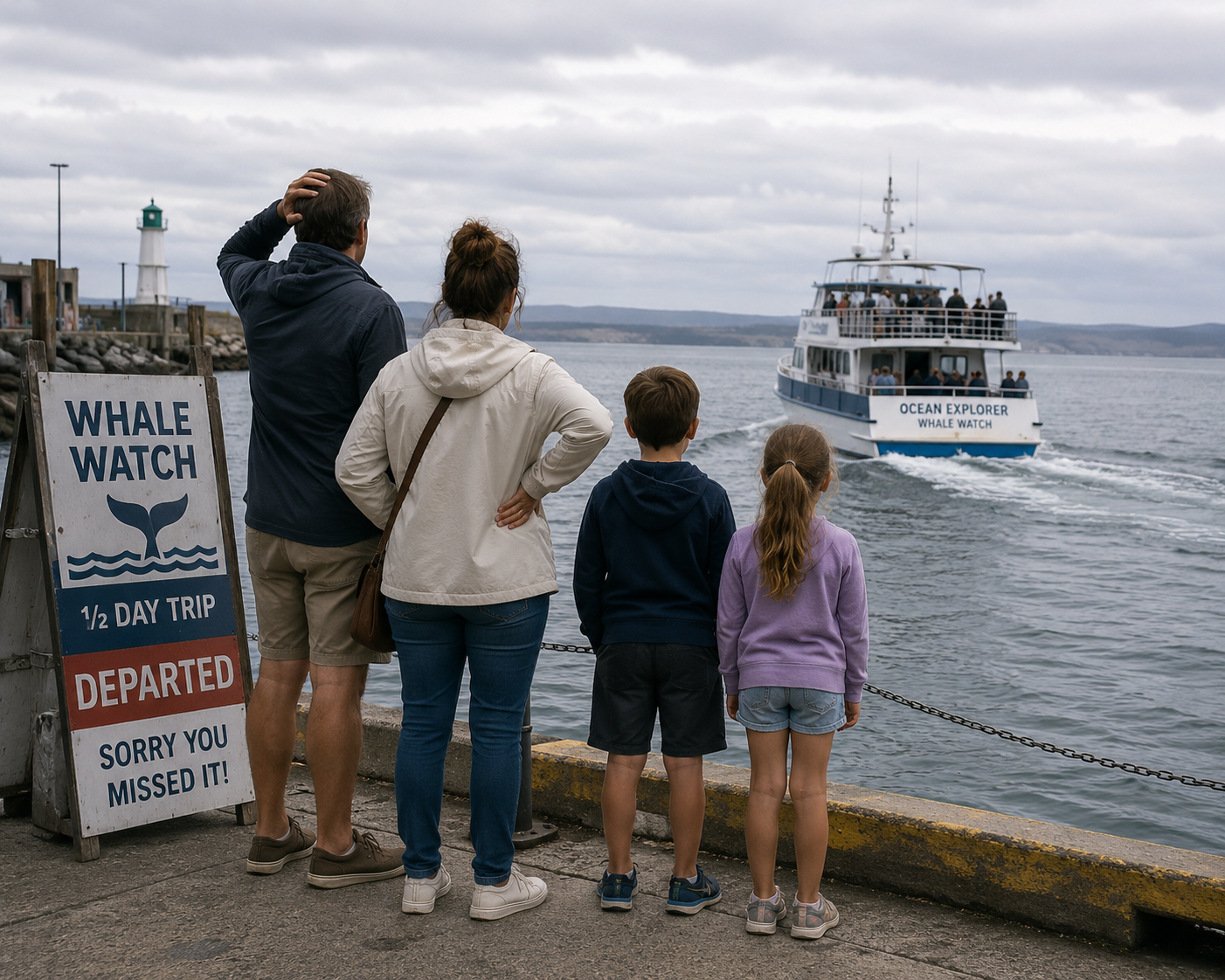
A family of four books an 8am whale-watching trip. Their booking value is $360. They don't show up on time.
The boat departs at 8:05am with their four seats empty. The boat runs anyway, fuel cost identical, captain on the clock, naturalists and crew working the deck. By 12:30pm the trip is over and you've kept the $360, because your no-show policy says so.
So what did that no-show cost you? The instinctive answer is "nothing, we kept the money." The actual answer is more interesting, and more uncomfortable, and worth understanding properly because most of us underestimate it by a wide margin.
The Direct Cost (Which Is Smaller Than You Think)
Start with the easy part. You kept the $360 in revenue. The fixed cost of running the departure didn't change because the seats were empty. The marginal cost per guest (snacks, fuel, a small share of merchandise consumed) might have been $5 to $10 per person. So in the direct accounting, you actually came out ahead: $360 in revenue, zero variable cost, no labour to refund.
This is the math operators do in their heads, and it's the reason no-shows feel manageable. If they all paid in full and didn't show, that would be a great business.
But almost none of them do. Which brings us to the indirect costs, which is where the actual damage lives.
The Indirect Cost (Which Is Much Larger Than You Think)
A no-show seat isn't really a kept seat. It's a lost-twice seat, and here's why.
The seat couldn't be resold. Because the no-show didn't tell you they weren't coming, you didn't have the chance to offer the seat to anyone else. A customer who genuinely wanted an 8am whale watch that morning didn't get one, because your manifest showed full. They booked a different operator, or they didn't book at all. The opportunity cost on that seat is potentially full price.
The deposit or partial payment is a fraction of the seat value, not the full value. The math above assumed full prepayment. In reality, many operator no-show policies forfeit a deposit (often 25% to 50%), not the full booking value. So you're not really keeping $360 on that family of four; you're keeping somewhere between $90 and $180, and you've lost the chance to sell those seats to anyone else.
Marketing and acquisition cost was already spent. Whatever it cost you to acquire that booking (OTA commission, marketing, staff time) was incurred. If the customer is now a no-show, the acquisition cost is mostly wasted, because they're unlikely to rebook and they're unlikely to refer.
The downstream relationship is over. A no-show isn't going to leave a review, isn't going to come back, isn't going to recommend you. The lifetime value of that customer is zero. For most operators, lifetime value is meaningfully higher than first-booking revenue, and that's all gone.
When you put this together, the actual cost of a no-show isn't "the marginal cost saved minus the deposit kept." It's something more like "the full opportunity cost of an unsold seat plus the wasted acquisition cost PLUS the foregone lifetime value." That number, for a typical $90 per guest tour, often lands between $40 and $80 per no-show seat.
Now multiply by your no-show rate.
The Math at Scale
How you communicate with your guests prior to departure, will influence your percentage of no-shows:
- Well-structured tourism bookings: ~3–10% no-show
- Loosely committed / flexible bookings: ~10–20%
If you run 200 departures a year averaging 40 seats each at $90 a seat, that's 8,000 seats and $720,000 in revenue.
A 3% no-show rate (which is on the low end for our industry) is 240 no-show seats a year. At a minimum actual cost of $40 per no-show seat, that's $9,600 in lost economic value. Not majorly catastrophic, but real.
A 10% no-show rate (more typical for shared group tours with last-minute online bookings) is 800 no-show seats. At $40 per seat, that's $32,000. Now it's a number worth paying attention to!
A 20% no-show rate (not uncommon for any operator with weak pre-arrival communication) is 1,600 no-show seats. At $40 per seat, $64,000. Or roughly the same as the cost of one additional staff member for the year!
The number you should know is your own. Most operators don't.
Why No-Show Rates Vary So Much
A few factors drive the rate up or down, often more than operators realise.
Lead time at booking. Customers who book three months out are more likely to forget, lose their plans, or simply not show. Customers who book inside 24 hours rarely no-show because their commitment is fresh.
Prepayment vs deposit. Full prepayment significantly reduces no-shows, because the customer has already absorbed the financial cost of cancelling and is more likely to come, or to actively cancel and try for a refund. Deposit-only bookings have higher no-show rates.
Pre-arrival communication. The single highest-leverage factor. Operators with no pre-arrival communication often see no-show rates in the 10% to 15% range. Operators with a three-touch confirmation sequence (booking, 48 hours out, day-of or day-before) usually see rates between 2% and 5%.
Product type. Free or low-cost experiences have dramatically higher no-show rates than premium or private experiences. A $200 private kayak tour will no-show at a small fraction of the rate of a $25 walking tour.
Booking channel. OTA bookings often no-show at slightly higher rates than direct bookings, because the customer's relationship is with the OTA rather than the operator. Direct bookings, with more touchpoints and a clearer sense of the operator as a real business, tend to convert to attendance more reliably.
What Actually Reduces No-Shows
Three categories of intervention move the needle. The third one is by far the most effective and the least implemented.
The deposit and prepayment lever. Charging in full or charging a meaningful deposit (40% or more) shifts the customer's psychology. They've already paid; they show up. This is a structural change to your booking model, so it has trade-offs (it can reduce conversion at the checkout stage), but for operators running deposit-light models with high no-show rates, the math often supports moving toward full prepayment.
The booking-time commitment. Some operators ask the customer to enter a phone number, confirm a specific arrival time, or acknowledge the no-show policy explicitly at checkout. These small commitment-increasing steps modestly reduce no-show rates. The improvement is real but limited.
The pre-arrival communication sequence. This is the highest-leverage intervention. A three-touch sequence with the right structure routinely drops no-show rates from double-digit to low-single-digit percentages. The structure that works:
Touch one: 48 hours before departure. A friendly message with practical detail: meeting point, what to wear, weather expectations, parking instructions, a phone number to call. Includes a soft "if your plans have changed, please let us know so we can offer the seat to someone else" line. This is the touch that recovers cancellations early enough to resell.
Touch two: 24 hours before departure. A confirmation request. "We're looking forward to seeing you tomorrow at 8am. Can you reply YES to confirm?" A one-click confirmation request. The act of confirming reinforces commitment, and the customers who can't make it are flushed out before the morning.
Touch three: two to four hours before departure. A "see you soon" note with the most practical day-of information. Meeting point with a map link, what time to arrive, parking. The reminder that converts the wavering customer into the showing customer.
These three messages, automated, sent reliably, cost approximately nothing per booking. They reduce no-shows by a factor that usually pays for the entire customer support automation stack on their own.
The Deposit Question
A lot of operators ask whether they should move from deposit-based booking to full prepayment to reduce no-shows. The honest answer is: it depends.
Full prepayment reduces no-shows. It also reduces conversion at booking, because some customers prefer to pay the balance later. For most shared-group products at moderate price points, full prepayment is now the norm and the conversion penalty is minimal. For higher-priced private experiences, deposit-based booking can still convert better and the no-show rate is lower anyway because of the price point.
If you're running deposit-based booking on a low-to-mid-priced shared product and you have a no-show rate above 8%, the move to full prepayment is probably worth it. Below that threshold, the math is closer.
What the No-Show Rate Is Telling You
A high no-show rate isn't really a customer problem. It's an operational signal. It tells you something about your pre-arrival experience, your booking model, your communication discipline, or all three.
The operators who treat no-shows as inevitable absorb the loss and move on. The operators who treat them as a fixable problem usually fix them, often dramatically, within a single season. The difference between a 10% and a 3% no-show rate isn't strategic genius; it's communication infrastructure.
Dazhboards' operations module runs the pre-arrival communication sequence automatically against the booking data, including SMS for the 24-hour and day-of touches where the open rate dwarfs email. The reduction in no-shows tends to be one of the most measurable wins operators see in the first 30 days after switching on the sequence; it's also one of the easiest to attribute, because the historical rate is right there in your booking data.