

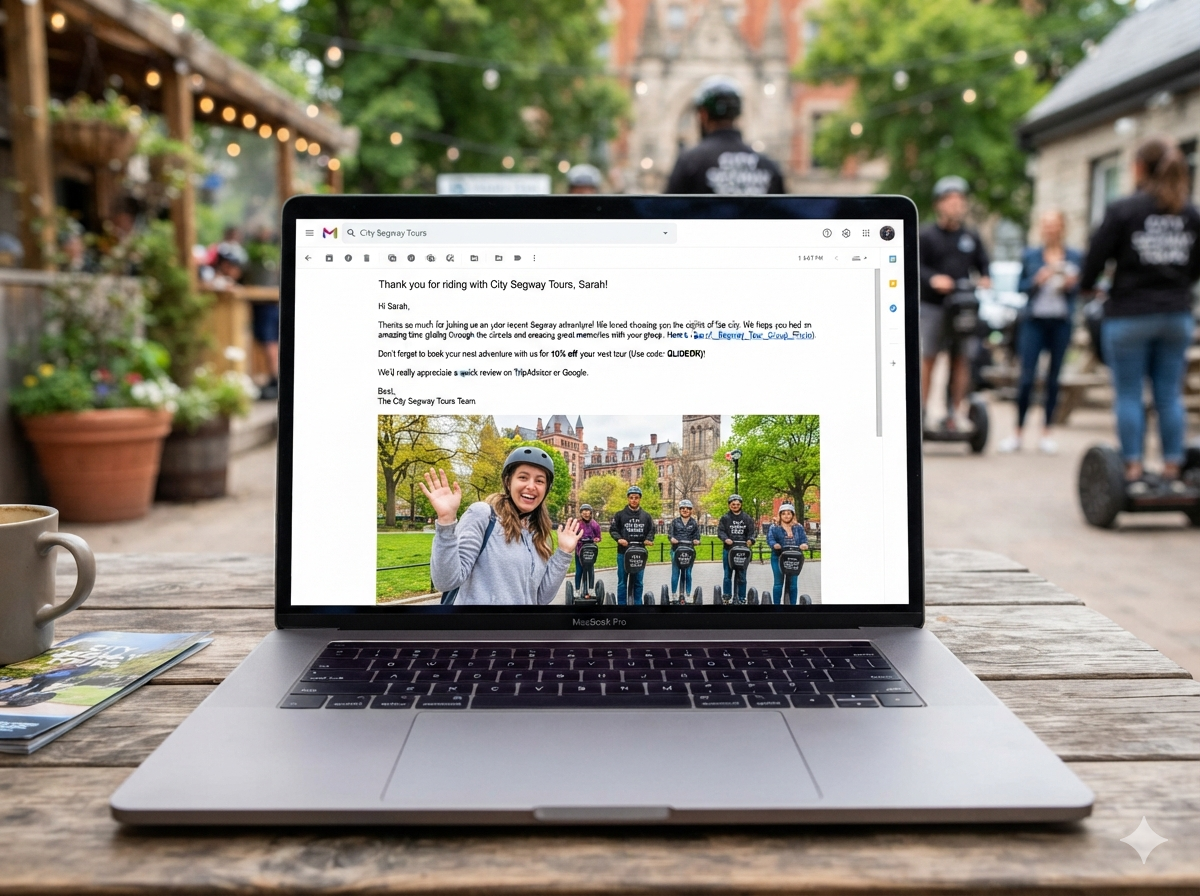
Most of us send one email after a tour. It says "thank you" and maybe asks for a review. Then nothing. The customer has had a good experience, paid their money, and disappeared into the rest of their trip. We won't hear from them again, and they probably won't hear from us.
This is a missed opportunity hiding in plain sight. Customers who have just experienced something with us are warmer to our brand than any cold prospect will ever be. The cost of staying in touch with them is essentially zero. And the rebooking and referral rates that result from doing this well, even moderately well, are higher than most operators realise.
The framing shift: post-experience communication isn't an afterthought. It's the most efficient marketing channel you have. Here's how to use it.
Why Most Post-Experience Email Programs Fail
The standard mistake is to send one email shortly after the experience and consider the job done. The reasons this fails are worth understanding.
The single email tries to do too much at once. Thank you, please review, here are other tours we offer, follow us on Instagram, sign up for our newsletter. The customer reads it as marketing noise and archives it.
The timing is wrong. The single email usually arrives within an hour of the experience, which is right for the review request but wrong for the rebooking ask. The customer who just finished a kayak tour isn't ready to think about their next visit yet.
There's no follow-up. The 95% of customers who don't immediately rebook hear from the operator zero times after the initial email. The relationship that was active and warm goes cold within a week.
The sequence that works is multiple, well-spaced, single-purpose touches over many months, each calibrated to where the customer is in their relationship with the operator.
The Five-Touch Sequence
The pattern that produces real repeat-booking lift looks roughly like this. Each touch has one purpose and is short enough to actually be read.
Touch one: same-day thank-you and review request. Sent within a few hours of the experience finishing, while the emotional intensity is still high.
The content is simple: a warm thank you, a photo or short reminder of the day, and one clear call to action, which is a review on the platform that matters most for your business. Not three platforms. One link.
This is the touch with the highest open rate of the sequence (often 60% or higher) and the most direct measurable purpose (review generation).
Touch two: three-day reflection. Sent two to four days after the experience.
By this point the customer has moved on with their trip, but the experience is still recent enough to be vivid. The right content here isn't a sales pitch. It's a reflection moment.
The format that works: a short note from the operator with one or two photos from the broader experience (not necessarily of the specific customer), a brief anecdote or fact about something they saw, and a soft invitation to share their experience with friends who might visit. No discount, no rebooking ask. Just connection.
This touch builds emotional loyalty more than it produces immediate revenue. Its job is to confirm that the operator is a real, present business, not a transactional vendor.
Touch three: two-week soft offer. Sent fourteen to twenty-one days after the experience.
By now the customer is back home (if they were a tourist) or settled back into routine (if they were local). The trip is becoming a memory.
The right content: a casual recap of what they did, a mention of related experiences they might enjoy (the sunset version of the morning tour, or a longer trip that includes their original experience), and a modest returning-guest offer that's clearly framed as a thank-you, not a sales push.
For local customers, this touch is the one that produces the most direct second bookings. For tourists, it lays the groundwork for a return trip planned later.
Touch four: three-month seasonal check-in. Sent quarterly, ideally tied to the season the customer originally visited in or to a seasonally relevant offering.
This is the touch most operators skip entirely, and it's the highest-leverage one for long-term repeat business. The customer who came in July might be receptive to a "summer is back" email the following May. The customer who came on a fall foliage tour might want the spring wildflower version next April.
The format: a single-purpose seasonal hook, a relevant offering, and a soft path to book. Not a newsletter. Not a list of multiple tours. One thing, one season, one ask.
Touch five: annual anniversary. Sent one year after the original experience.
A short message: "It's been a year since you joined us for [specific experience]. We hope you're well. If you're back in town, we'd love to see you again." A modest gesture, like a small returning-guest credit, makes the message land more concretely.
This touch performs surprisingly well. The combination of nostalgia (it's been a year), specificity (mention the exact experience), and modest incentive often converts dormant customers back into active ones at rates that justify the entire sequence.
What Goes In Each Touch (And What Doesn't)
The discipline that separates a working sequence from a noisy one is single-purpose touches. Each email should have one job. The audience can tell when an email is trying to do too much, and they disengage.
The same-day email is about the review. Everything else is decoration.
The three-day email is about connection. No sales asks at all.
The two-week email is about a soft rebooking opportunity. One offering, modest framing.
The seasonal email is about a specific relevant moment. Not the full menu.
The anniversary email is about being remembered. Light on the sales angle, heavy on the warmth.
This discipline matters because the cumulative effect of the sequence depends on the customer staying subscribed. Heavy-handed emails generate unsubscribes that close the relationship permanently. Light, single-purpose emails generate engagement that stays open over years.
The Segmentation That Matters
A few segmentation moves substantially improve performance. They're worth doing even with a basic email tool.
Local vs visitor. Local customers can rebook anytime; visitors usually can't. Local sequences emphasise immediate repeat business; visitor sequences emphasise seasonal return trips and referrals to friends visiting the destination.
Party type. A couple, a family, a corporate group, and a solo traveller respond to different framings. The same experience is "your romantic anniversary kayak trip" to one customer and "the family adventure morning" to another. Sequence content should reflect.
Season visited. A customer who came in summer is a candidate for "the summer experience is back" emails. A customer who came in winter is a candidate for very different timing.
First-time vs returning. A first-time customer needs different content than a third-time repeat. The repeat sequence should acknowledge the relationship: "for your third visit, we'd love to show you something different than the standard tour."
Even simple two-axis segmentation (local/visitor and season) produces meaningfully better results than a single one-size-fits-all sequence.
The Unsubscribe Question
Every email program produces unsubscribes. The question is how to think about them.
The instinct is to minimise unsubscribes at all costs. This produces tame, generic emails that don't unsubscribe anyone but also don't drive bookings.
A more useful framing: unsubscribes are part of the program working correctly. The customer who unsubscribes was probably not going to rebook anyway, and now they're not receiving emails that would have damaged their impression of the brand had they continued reading them.
The unsubscribe rate to watch is the second-derivative one: if a specific email or sequence is driving unsubscribes at notably higher rates than the rest of your program, something about it is misfiring. Adjust that specific email. Don't water down the whole sequence.
The healthier metric to watch is engagement among the people who stay subscribed: open rates, click rates, and ultimately repeat booking rates. These are the numbers that matter for revenue.
A Note on Frequency
A common error is sending too often. The five-touch sequence above is calibrated to stay below most customers' irritation threshold while still maintaining presence.
Email programs that send weekly newsletters to every past customer tend to produce higher unsubscribe rates and lower repeat booking rates than the more disciplined approach. The customer who hears from you five times a year, each time with something specific and relevant, is more receptive than the one who hears from you fifty times a year, each time with general news.
The discipline is harder than it sounds. The operator who hasn't sent anything for three months tends to want to "catch up" with a bigger email. Resist this. Better to skip a touch than to overcompensate.
A Closing Thought
The customers who have already experienced your business are the most efficient revenue source you have. They've spent acquisition cost once; everything beyond that is incremental margin. They've already established trust; the marketing job is much easier. They've seen the product; you don't have to convince them it's worth it.
The fact that most operators barely communicate with this audience after the experience is, in retrospect, surprising. It's the cheapest, warmest channel available, and it's underused. It could increase your repeat customers by 48%!
The operators who build a real post-experience program tend to see compounding repeat-booking rates over years. The compounding works because the program improves with data, the relationship deepens with each touch, and the customer base grows even when consumer acquisition slows.
Dazhboards' marketing module runs the post-experience sequence with the segmentation built in, tied to the booking data so the touches actually reference the customer's real experience rather than generic templates. The sequence pays for itself in repeat-booking lift; the customer relationship that develops alongside is the longer-term return.