

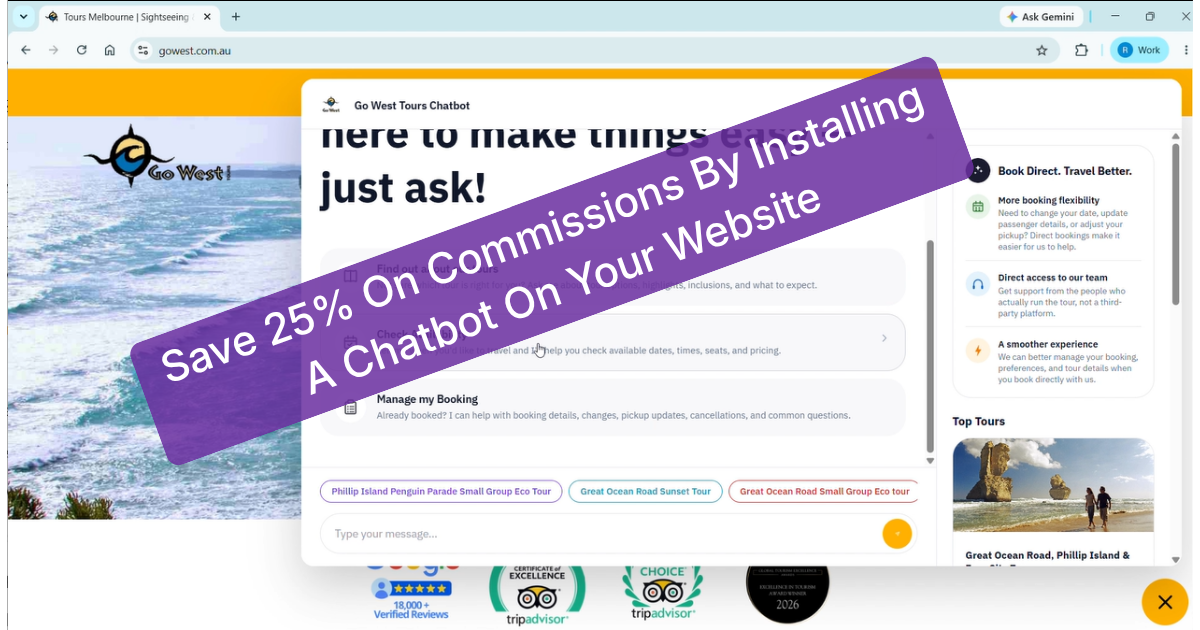
When's the last time you actually measured how long it takes you to respond to a direct booking inquiry?
Most of us don't. We have a vague sense of "pretty quickly" that, in reality, translates to anywhere between fifteen minutes and eighteen hours depending on what's happening on the tour that day, whether your child is sick, and whether anyone remembered to check the inbox after the 3pm departure left.
Meanwhile, the confirmation email from GetYourGuide or other OTAs lands in the customer's inbox in about thirty seconds.
We need to talk about this.
The Shift That Already Happened
Booking behaviour has changed in ways most of us haven't fully reckoned with. Customers researching tours and activities are now in roughly the same headspace as someone shopping for a flight or a hotel. They open three or four tabs, send a couple of inquiries, and will usually book whichever one resolves their question first.
The window in which a customer is "active" on a purchase decision is shorter than it used to be. We've seen the data move around, but a fair working assumption is this: inquiries that go more than two hours without a substantive reply convert to bookings at less than half the rate of inquiries answered inside fifteen minutes.
Let that sink in for a moment.
It's not because the customer is impatient. It's because they're parallel-shopping, and the first credible answer they get tends to win.
The Operator Problem
The standard operator response to this is some variation of: "We're a small team, we're running tours all day, of course we can't reply in fifteen minutes."
Fair. The expectation that a four-person operation will match the response time of a venture-funded OTA is unrealistic. But the conclusion most of us draw from that, that we just have to accept the lost bookings, isn't the only conclusion available.
The actual question is: what's the minimum credible response that resolves the buyer's immediate need? Because in most cases, the customer isn't asking a question that requires deep operator knowledge. They're asking one of about five things:
- Is the date and time available?
- How much is it for our group size?
- Where do we meet?
- What should we wear or bring?
- Is it suitable for our kids, our grandparents, our skill level?
Every one of these has a deterministic answer that doesn't require us to be in the inbox at 9pm.
The Two-Layer Reply
The pattern that works for most operators is a two-layer response.
Layer one is an immediate, automated reply that hits within sixty seconds and resolves the simple, factual questions. Availability check, pricing for the requested group size, meeting point, suitability indicators. This isn't a generic "thanks for your inquiry, we'll get back to you" autoresponder. That message actively hurts conversion now, because customers read it as a stall.
The first reply needs to do real work. If they asked about Saturday at 10am for four adults, the reply needs to say: yes, Saturday at 10am has availability for four adults, the price is $X, meeting point is here, here's what to bring, and here's the link to confirm.
Layer two is the human follow-up for anything the automated reply couldn't handle. Custom group sizes, special needs, multi-day combinations, questions about whether the dolphins have been around lately. This can wait two hours, or even six, because the urgency has been defused by the first reply.
What Automated Replies Used to Mean (And What They Mean Now)
There's an old reflex in our industry to resist anything that sounds automated. The fear is that customers will feel they're not being treated personally and will book somewhere that feels more human.
That fear is based on what automation used to be. The autoresponders we all hated were the ones that just said "we received your message" and left you waiting. They added no value and signalled inattention.
Modern AI-handled replies are different. They actually answer the question. Done well, they're indistinguishable from a fast, well-informed human reply, because they're drawing from the same FAQ, the same calendar, the same pricing rules a human would use. The customer gets what they need, and the relationship starts on a positive note.
The operators getting this right are not "less personal" than the ones who reply in five hours from their phone while parking the van. They're more responsive, more accurate (because the automated reply doesn't get the price wrong when tired), and the customer doesn't sit in limbo.
The Numbers That Matter
If you want to actually measure whether response time is hurting you, three numbers are worth tracking.
First, time-to-first-substantive-reply. Not "time-to-acknowledgement", which is the dishonest version. The clock stops when the customer's question is actually answered.
Second, inquiry-to-booking conversion rate, segmented by response time. If you can pull six months of inquiries and tag them by how fast they were resolved, the pattern usually appears clearly. The drop-off after the first hour tends to be steep.
Third, the percentage of inquiries that come in outside of business hours. For most operators this is between 40% and 60%. Anything you don't have a system for handling outside business hours is, by default, going to OTAs.
The Honest Trade-off
Automating the first reply does create a few real trade-offs, and it's worth being honest about them.
Some inquiries are genuinely complex and benefit from a human reading the whole context before replying. An auto-reply that confidently quotes a price for a group that turns out to need a custom itinerary can make things awkward. The fix is to design the automation to escalate gracefully: when the inquiry contains signals that mean "this isn't a standard booking", the system passes it to a human without sending the templated response.
There's also a small percentage of customers who genuinely prefer a slower, more conversational booking process. They're rare, and they're usually shopping for high-value private experiences. Build a path for them, but don't optimise for them at the expense of the majority who want their question answered now.
What Good Looks Like
The operators who handle this best have, in practice, achieved something close to OTA-level response speed on their own channel without hiring more staff. Their flow looks roughly like this:
An inquiry arrives. Within sixty seconds the customer receives a reply that addresses their actual question with the relevant data pulled from the booking system. A booking link is included. If the customer books, the system handles it. If the customer has follow-up questions, those route to a human who picks them up during business hours, knowing the simple stuff is already handled.
The result, in most cases, is a measurable lift in direct conversion. Sometimes substantial. The bookings that used to drift to OTAs now stay direct.
A Closing Thought
We've spent a lot of years in this industry treating response time as a customer service problem. It isn't. It's a conversion problem, and it's probably the single most leveraged conversion problem most of us have.
The good news: it's also one of the most solvable, and unlike most other conversion levers, you don't need to change anything about your product, your pricing, or your marketing to fix it. You just need to be there when the customer is.
Dazhboards' AI customer support module exists for exactly this reason: catching the inquiry inside the first minute, answering the question that's actually being asked, and handing the conversation back to a human only when it genuinely needs one. We built it because we got tired of losing bookings to the OTAs at 9pm.