

Upsell and Cross-Sell Mechanics for Activity Operators
The fastest path to margin expansion isn't more bookings. It's bigger bookings. And most of us are leaving substantial money on the table because we don't have a real upsell motion built into our customer experience.
This isn't about pressure selling. The operators who feel uncomfortable with "upsell" usually have in mind the airline check-in upgrade pitch or the rental car insurance hard sell. Those experiences are unpleasant because they're designed to be unpleasant. Done well, upselling in our industry is the opposite: it's the customer thanking you for letting them know about something they actually wanted.
Here's what the operators with materially higher average order values are doing.
The Math Argument for Upselling
If your average booking is $95 and you can lift it to $115 through well-designed add-ons, you've increased revenue per booking by about 21%. None of that incremental revenue carries acquisition cost, because the customer is already yours. The marginal cost of fulfilling most upsells is low. So roughly 80% to 90% of the additional revenue flows to margin.
In practical terms, a small operator doing 1,500 bookings a year who lifts AOV by $20 captures an extra $30,000 in revenue with almost no extra fixed cost. That's often more impactful than spending the equivalent in marketing to acquire net-new bookings.
This math is the reason every other consumer-facing industry has built upselling into the booking flow. Hotels, airlines, restaurants, ride-shares. Tours and activities is one of the last categories to systematise this, and the operators who do it well capture meaningful margin from a customer base they already have.
Where Upsells Actually Work
Not every product supports upselling. The conditions that make upsells work are specific.
Customer-perceived value. The add-on has to be something the customer genuinely wants, not something the operator wants to sell. Photo packages, food and drink upgrades, transportation, premium gear, longer durations, and exclusive access all tend to work because customers can see the value clearly.
Marginal-cost-favourable. Upsells that cost the operator little to deliver (the photo download you'd take anyway, the slightly larger boat you'd run anyway) carry strong margins. Upsells that require new fulfilment infrastructure (catered meals, transportation logistics) need to be priced to cover their actual cost, including the operational complexity.
Easy to deliver. An upsell that breaks your operation by adding a complicated touchpoint isn't worth the revenue. The best upsells slot into the existing fulfilment flow without making the experience worse for non-upsellers.
Honestly described. Customers can tell the difference between a real upgrade and a fake one. The "premium" upgrade that's actually identical to the standard product, just labelled differently, erodes trust faster than no upsell at all.
The Four Upsell Moments
There are four points in the customer journey where upsells convert, each with different mechanics.
At checkout. The classic. After the customer has chosen their tour and quantity but before they pay. This is the highest-converting upsell moment because the buyer is in a purchasing state of mind and the friction of adding to the order is low.
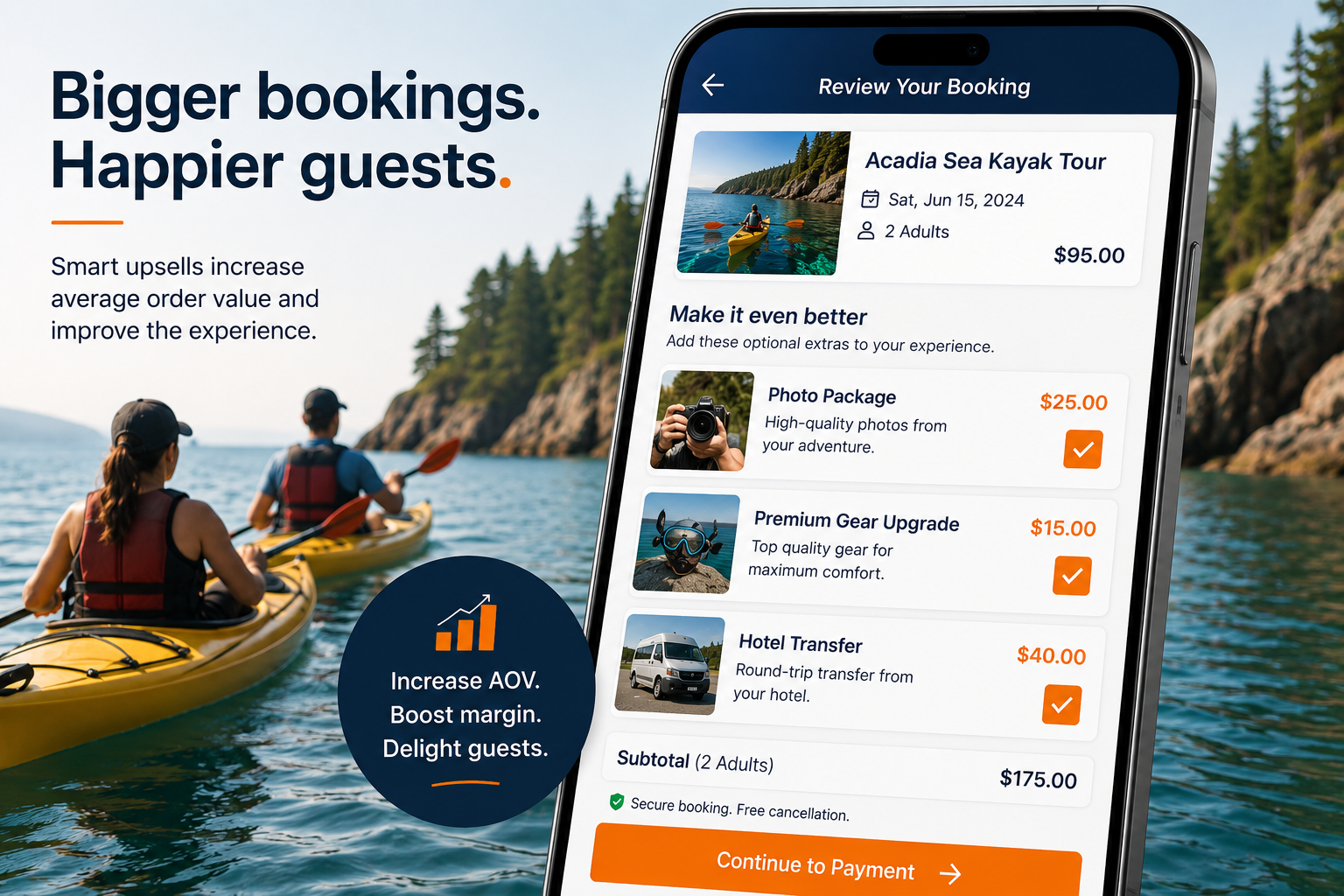
What works at checkout: clear, simple add-ons displayed inline. Photo package $25. Lunch upgrade $15. Premium snorkel gear $10. Private transfer from your hotel $40. The display should look like a checkbox menu, not a sales pitch. The customer can add what they want without leaving the booking flow.
What doesn't work: large modal pop-ups that interrupt the booking flow, time-pressure tactics ("offer expires in 5 minutes!"), or add-on bundles that obscure individual prices.
Pre-arrival. Between booking and the day of the experience, the customer has time to consider extras. This is the second-most-effective upsell window, and most operators don't use it at all.
What works pre-arrival: a single, well-timed email two or three days before the experience offering one or two relevant add-ons. "We're looking forward to seeing you Saturday. If you'd like to add a photo package or upgrade to a premium seat, you can do that here." Soft, no pressure, easy to act on.
The conversion rate on these emails varies wildly by product and timing, but for most operators it's in the 8% to 15% range, which is significant additional revenue from a customer who has already paid.
During the experience. The most delicate upsell moment, and the one where bad upselling damages the experience the most.
What works in-experience: the guide casually mentioning an add-on at a natural moment. "If you want to extend an extra thirty minutes at the sunset spot, we can do that for an extra $20." The customer can say yes or no without anyone losing face. The guide is offering, not pitching.
What doesn't work: scripted in-experience upsell pitches that feel pre-rehearsed. Customers can detect this within about ten seconds and it makes the whole experience feel commercial. The best in-experience upsells are improvised, contextual, and feel like the guide is doing the customer a favour.
Post-experience. The cross-sell, more than the upsell. The customer has had a good experience and is now susceptible to "what else might I do here?"
What works post-experience: an email a day or two later mentioning related experiences ("if you enjoyed today's morning tour, our sunset version is a completely different experience and most of our morning guests come back for it"), with a small returning-customer incentive if appropriate ($10 off, modest enough to be a thank-you rather than a discount). This is where lifetime value expansion happens.
The Specific Add-Ons That Tend to Convert
A pattern across operators in our industry: certain add-on categories convert reliably, others struggle.
Photo and video packages are among the highest-converting add-ons in the industry. Customers want professional shots of the experience and increasingly expect them. A $25 to $40 photo package attached to most experiences converts at 20% to 40% depending on the product, and the marginal cost (a guide with a camera, plus a sharing platform) is low.
Food and drink upgrades convert well when they're genuinely better than the standard. A real lunch instead of a snack pack. A glass of wine on a sunset tour. A coffee and pastry on a morning walk. They convert poorly when they're trivial or feel mandatory.
Private or premium versions of shared experiences convert at low percentages but at high dollar values. Two or three customers per season upgrading from shared to private can be more revenue than fifty photo package add-ons.
Transportation add-ons (hotel pickup, return transfer) convert well in destinations where guests don't have cars and underperform in destinations where they do.
Merchandise rarely converts as a checkout upsell but sometimes converts as a post-experience offer, particularly when tied to a photo or memory of the day.
Skip-the-line or priority access add-ons work where there's a genuine queue and don't work where there isn't.
The Avoid List
A few upsell patterns reliably backfire.
The drip-priced upsell. Where the headline price is one number, but adding what most customers consider essentials (transport, equipment, lunch) pushes the actual price up by 40%. Customers feel deceived and it shows in reviews.
The mandatory upgrade. Where the "standard" option is deliberately worse than what a reasonable customer would expect, pushing them toward the upgrade. Same problem; customers can tell.
The high-pressure in-experience pitch. Where the guide spends meaningful time selling rather than guiding. The experience itself suffers and the upsell doesn't convert.
The bundled package that obscures pricing. Where you can't tell what each component costs. Customers prefer transparency, and pricing transparency in your upsells tends to lift conversion, not lower it.
A Practical Starting Point
If you're not running any structured upselling today, the lowest-effort starting move is one checkout add-on and one pre-arrival email.
For the checkout add-on, choose the one most clearly aligned with what your customers already ask about. If guests routinely ask about photos, it's a photo package. If they ask about transport, it's a transfer. If they ask about food, it's a meal upgrade. The "what do customers ask about that we're not offering?" question usually answers itself once you listen for it.
For the pre-arrival email, send it 48 hours before the experience, mention one specific add-on, link to a checkout flow that lets them add it without rebooking. Track the conversion rate over your first ten emails and refine from there.
This minimal starting point usually lifts AOV measurably within a single season, and gives you the data and confidence to build out the rest of the program.
A Cultural Note
The operators who feel most uncomfortable with upselling are often the ones for whom upselling would work best, because their customer base trusts them. The trust they've built means customers are happy to accept a recommendation when it's offered well, and resentful only when it's offered badly.
Trust well-spent earns more trust. Trust badly-spent loses it. The operators who treat upsells as a service to the customer ("here are the things other guests like you have enjoyed adding") build more trust through the offer itself. The operators who treat upsells as a transaction tend to find their customer satisfaction declining alongside their AOV improvement.
Dazhboards' sales tracking and AI support modules handle the upsell mechanics: checkout add-ons, pre-arrival emails, post-experience cross-sells, and the data to see which ones are actually converting for which customer segments. The hardest part of running an upsell program is the structure; the customers are usually ready to spend more if you make it easy for them.