

The Market That Never Flies Home: Why Most of Us Ignore Locals, and Why That's Expensive
At a gathering of operators a couple of winters back, someone asked the room a question that landed harder than she probably intended: "What percentage of your guests live within an hour of your meeting point?"
Most of us guessed under five percent. One operator, who runs food experiences in a mid-sized city, said forty. The room assumed she had misheard the question. She had not. She had spent three years deliberately building a local audience, and it had quietly become the most stable part of her business: guests who book in the off season, return with different friends, buy vouchers every December, and never once asked her about airport transfers.
The rest of us had all made the same unexamined assumption: tours are for tourists. It is worth examining, because the assumption costs more than it appears to.
What a local guest is actually worth
Compare the economics of a tourist guest and a local guest honestly.
The tourist books once, on their one visit, often through a channel that takes a commission. They book in peak season, when your capacity is scarcest. However delighted they are, their repeat probability is close to zero; the review and the word-of-mouth to other travelers are the residual value, and both are real but diffuse.
The local can book repeatedly. They fill your shoulder season and midweek departures, exactly the capacity that otherwise runs empty. They book direct, because they found you through local channels rather than a marketplace built for trip-planners. They bring visiting friends and family, which converts them into a distribution channel for tourist guests. They buy gift vouchers for people they know, and they turn up at short notice when weather clears, because they live twenty minutes away.
One local guest who returns twice and gifts one voucher is worth several tourist bookings, acquired at a fraction of the cost. The lifetime-value math that platforms and marketers preach at us actually applies here, because locals are the only segment where a lifetime exists.
Why locals don't book, and why it's our fault
The reflex objection is "locals aren't interested in tours of their own city." Partly true, and mostly a framing problem we created.
Everything about how most of us present ourselves tells locals this is not for them. Our marketing shows suitcases and landmarks. Our copy says "discover the city," which a resident reads as "you already know this." Our schedules cluster in tourist patterns. Our channel mix, OTAs and hotel desks and airport racks, physically cannot reach someone who lives here.
Locals do spend on experiences constantly: restaurants, concerts, weekend workshops, escape rooms, wine tastings. The market exists. It just does not recognize itself in a product framed as sightseeing.
The operators who crack this segment reframe rather than rebuild. The same walking tour becomes "the stories your city never told you." The food tour becomes "the five places you've walked past a hundred times." The framing that works on locals is insider access and social occasion, not orientation. A local does not need to find the cathedral. They need a great answer to "what should we do for Sarah's birthday?"
Product moves that unlock the local market
Some of this is pure marketing; some needs modest product work.
Build occasion-shaped variants. Locals book experiences around occasions: birthdays, anniversaries, visiting in-laws, work socials, date nights. A private-group version of your existing product, priced for eight to twelve people with a "celebrate here" frame, sells to locals without changing the underlying tour. Corporate team outings are the same product wearing a collared shirt, and they book midweek, in daytime slots you struggle to fill.
Use your off-peak inventory as the offer. The seats you cannot sell to tourists are the exact seats locals can flexibly take. A locals-only rate for midweek and shoulder-season departures, gated by postcode or a resident sign-up list, fills empty capacity without discounting the peak inventory tourists compete for. Framed as a resident perk rather than a clearance sale, it builds the audience instead of cheapening the brand.
Rotate something. The hardest local objection is "we already did it." Tourists never say this; locals will after one visit. A seasonal special, a new neighborhood, a guest expert, a themed evening a few times a year gives past local guests a reason to return and gives your local marketing something new to say. This is genuine extra work, and it is the honest price of a repeat market.
Reaching people who will never search "things to do in [your city]"
Local acquisition runs on entirely different channels, which is why our tourist-tuned marketing never touches them.
The channels that work: local press and city blogs, which are permanently hungry for "hidden gems" stories and will cover a genuinely local angle; community groups and neighborhood social media, where one enthusiastic resident's recommendation carries absurd weight; partnerships with local businesses whose customers match yours, the wine shop, the bookshop, the gym; gift guides in December, where your voucher belongs; and your own past-guest list, which already contains more locals than you think, sitting there mislabeled as one-time tourists.
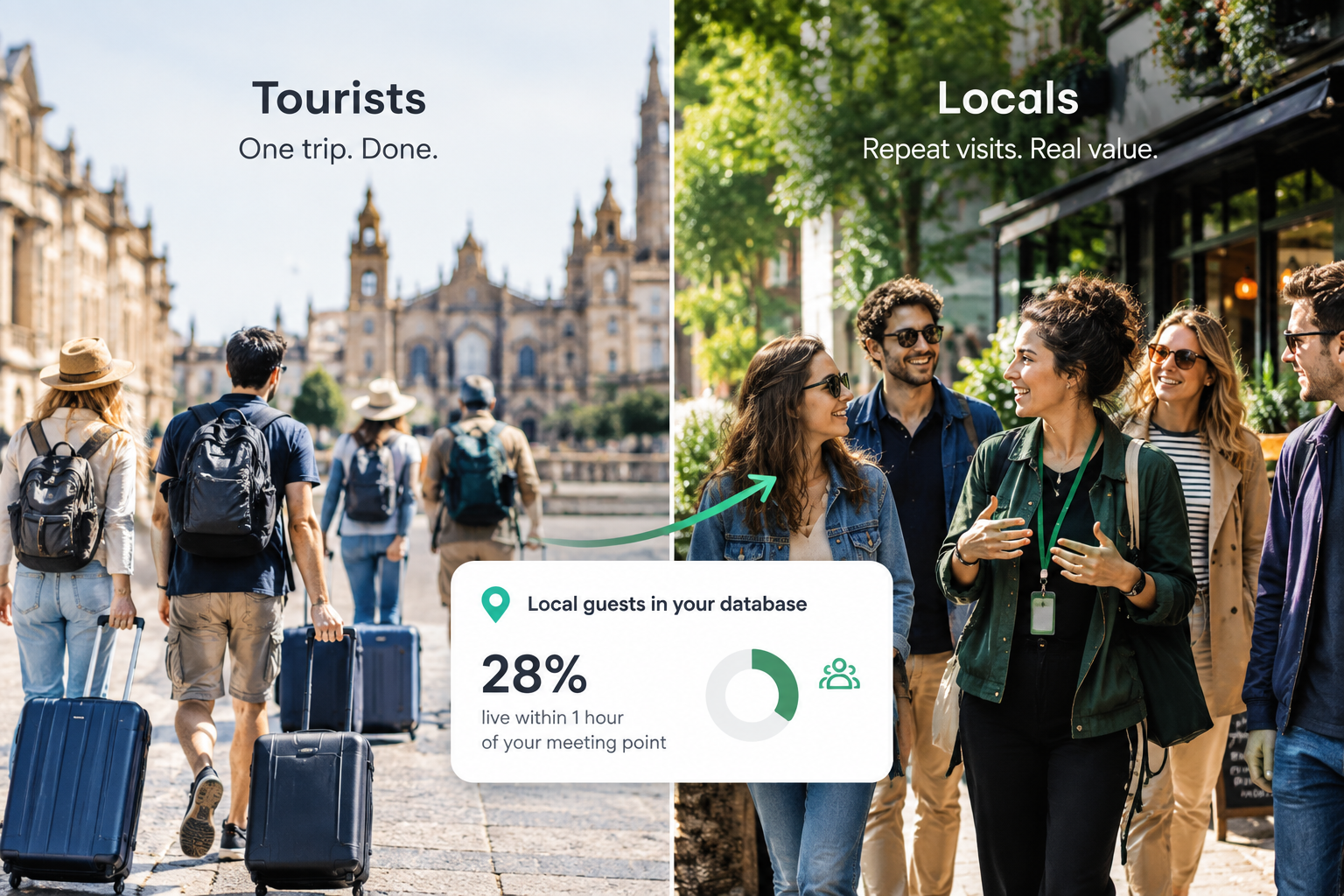
That last one is the cheapest starting point. If you can filter your booking history by home location, do it this week. The residents in that list are your seed audience: invite them to something, tell them about the locals' rate, ask them what would bring them back. Segmenting our list this way in Dazhboards was genuinely the moment this stopped being theory for us; seeing the actual number of past guests within an hour's drive, and being able to market to them separately from international past guests, turned "locals" from an idea into a campaign we could run before lunch. Operator friends on other setups have done the same with exports and a spreadsheet; the tooling matters less than actually splitting the list.
The resident club: turning a segment into an institution
Once local bookings start flowing, a further move is available that tourist businesses can never make: formalizing the relationship. Call it a resident club, an insiders' list, a friends-of scheme; the mechanics matter more than the name.
The lightweight version costs almost nothing to run. Residents sign up with a postcode, and membership gets them the locals' rate on off-peak departures, first invitations to new products and special evenings, and occasional member-only dates. No card, no fee, no plastic; just a tagged segment of your list with its own email stream and its own perks. What you get in exchange is the marketing asset locals-focused businesses are built on: a named audience you can fill a Tuesday with, launch a pilot to, and survey when you are unsure what to build next.
The heavier version, a paid annual membership, works for some operators and products: a flat yearly fee for unlimited or discounted access to standard departures. Tread carefully here. Paid membership creates recurring revenue and real belonging, but it also creates an obligation to keep delivering fresh value all year, and it can cannibalize full-price local bookings if the price is set casually. The operators who make paid membership work tend to have genuinely rotating products and event calendars; if your lineup is stable, the free club captures most of the value at none of the risk.
Whichever version, the club solves the two structural problems of the locals market at once. Price sensitivity gets channeled into a controlled discount on capacity you were not selling anyway, instead of leaking into general discounting. And the need for freshness gets an audience worth building freshness for; a members' evening testing a new route is simultaneously product development, marketing, and the reason your locals feel like insiders rather than customers.
One rule keeps the whole thing honest: the club must stay a genuine privilege, not a mailing list with a fancy name. If member emails become indistinguishable from your general marketing, the asset dies quietly. Two or three genuinely member-first moments a year, an early booking window that is actually early, a date that really is members-only, is the maintenance cost of the institution.
The honest trade-offs
The locals market is not free money. Repeat demand requires product freshness, which is ongoing work. Local price sensitivity is real; residents benchmark you against restaurants and cinemas, not against holiday budgets. And a locals strategy takes seasons to compound, not weeks; the operator with forty percent local guests spent three years getting there.
But the strategic prize is the one thing tourist demand can never give you: a customer base that does not reset to zero every autumn. Tourists are a river; you fish it fresh every day. Locals are a reservoir, and every season you invest in it, it gets a little deeper. In a business as exposed to seasons, algorithms, and flight prices as ours, the reservoir is worth digging.